The way real estate professionals build relationships and generate referrals has fundamentally changed. Digital real estate networking is no longer a nice-to-have skill, it is the defining advantage separating top-producing agents from those struggling to keep up. While traditional networking methods like handing out paper business cards at mixers and cold-calling expired listings still have a place, agents who embrace a digital-first approach are consistently closing more deals, building stronger referral pipelines, and spending less time chasing dead-end leads. In this article, we explore why the shift toward digital networking is accelerating and how you can leverage it to grow your business.
The Shift Toward Digital Real Estate Networking
Real estate has always been a relationship business. That part has not changed. What has changed is how those relationships begin, develop, and convert into closed transactions. According to the National Association of Realtors (NAR), 52% of buyers found their agent through a referral from a friend, neighbor, or relative, while 28% used the agent they previously worked with. These numbers confirm that relationships drive business. But they also reveal something important: the agents who make it easiest to stay connected are the ones who earn those referrals.
Traditional networking relied on physical presence. You attended a chamber of commerce luncheon, swapped paper business cards, and hoped the other person did not lose your card before they needed an agent. Digital real estate networking flips that model. Instead of relying on a physical card that ends up in a junk drawer, digital-first agents create lasting, interactive touchpoints that keep them top of mind long after the initial meeting.
The pandemic accelerated this transition, but the trend was already well underway. Younger homebuyers and sellers, particularly millennials and Gen Z, expect a tech-savvy agent. An agent who still relies exclusively on printed materials and in-person mixers risks appearing outdated to the very demographic that represents the largest share of today’s homebuyers.
Where Traditional Networking Falls Short
Before diving deeper into the digital-first approach, it is worth understanding exactly where traditional networking methods break down. This is not about dismissing old-school tactics entirely. Some of them still work. It is about recognizing their limitations so you can make smarter choices about where to invest your time and energy.
The Paper Business Card Problem
The average professional receives hundreds of business cards per year. Studies suggest that roughly 88% of paper business cards are thrown away within a week. That means for every 100 cards you hand out at an event, only about 12 people will still have your contact information seven days later. That is a terrible conversion rate for something agents spend significant money printing and distributing.
Paper cards also carry zero interactivity. They cannot link to your listings, your reviews, your social media profiles, or your calendar. They are static, one-dimensional, and easily lost. In a competitive market where speed and convenience determine who wins the client, a paper card is a bottleneck.
Time-Intensive Events With Uncertain ROI
Attending networking events, hosting lunch-and-learns, and showing up at community gatherings all require significant time investment. For a busy agent juggling showings, negotiations, and client calls, spending three hours at a mixer to collect a handful of questionable leads is a tough trade-off. Traditional networking is inherently unscalable. You can only be in one place at a time, and there is no guarantee the right people will be in that room.
Slow Follow-Up Loops
Even when traditional networking events produce good contacts, the follow-up process is painfully manual. You collect a card, manually enter the information into your CRM, draft a follow-up email, and hope you have not waited too long. Research from HousingWire consistently shows that response time is one of the most critical factors in lead conversion. Every hour that passes between initial contact and follow-up reduces your chances of converting that lead.
What Digital-First Agents Do Differently
Digital-first agents do not just use technology for the sake of it. They use it strategically to remove friction from every stage of the networking and lead conversion process. Here is what sets them apart.
They Create Instant Digital Touchpoints
Instead of handing someone a paper card and hoping for the best, digital-first agents share their contact information through tools like RealConnect digital business cards. A single tap or QR code scan delivers their full professional profile directly to a new contact’s phone, complete with clickable links to listings, reviews, social media, and a scheduling tool. The contact is saved immediately, no manual entry required.
They Automate the Follow-Up
Digital-first agents integrate their networking tools with their CRM and email marketing platforms. When a new contact saves their digital card, that information flows automatically into their follow-up sequences. Within minutes, not hours or days, the new contact receives a personalized message. This speed creates a powerful first impression and dramatically increases conversion rates.
They Leverage Data to Prioritize
One of the biggest advantages of digital networking is the data it produces. Digital-first agents can see who viewed their card, which links were clicked, and how often someone revisited their profile. This data helps them prioritize their follow-up efforts, spending more time on warm leads and less time chasing people who were never serious prospects.
They Network 24/7
Traditional networking is limited to business hours and event schedules. Digital networking happens around the clock. When an agent’s digital card is shared via text, email, or social media, it can reach new contacts at any time. A single post on social media featuring a link to your digital card can generate more meaningful connections than an entire evening at a networking event.
How Digital Business Cards Transform First Impressions
First impressions in real estate are everything. A potential client’s initial perception of your professionalism, tech-savviness, and attention to detail will influence whether they choose to work with you. Digital business cards elevate that first impression in several important ways.
Professional and Modern Presentation
A well-designed RealConnect digital business card communicates that you are a forward-thinking agent who invests in their business. It tells potential clients that if you are this organized and tech-savvy in how you present yourself, you will bring that same level of professionalism to their transaction. In a market where consumers have more choices than ever, that perception matters.
Rich Media and Interactive Elements
Unlike a paper card limited to a name, phone number, and logo, a digital business card can include video introductions, virtual tour links, client testimonials, links to active listings, and direct scheduling buttons. This transforms a simple contact exchange into a mini portfolio presentation. The recipient immediately sees the value you bring, before you have even had a formal conversation.
Seamless Contact Saving
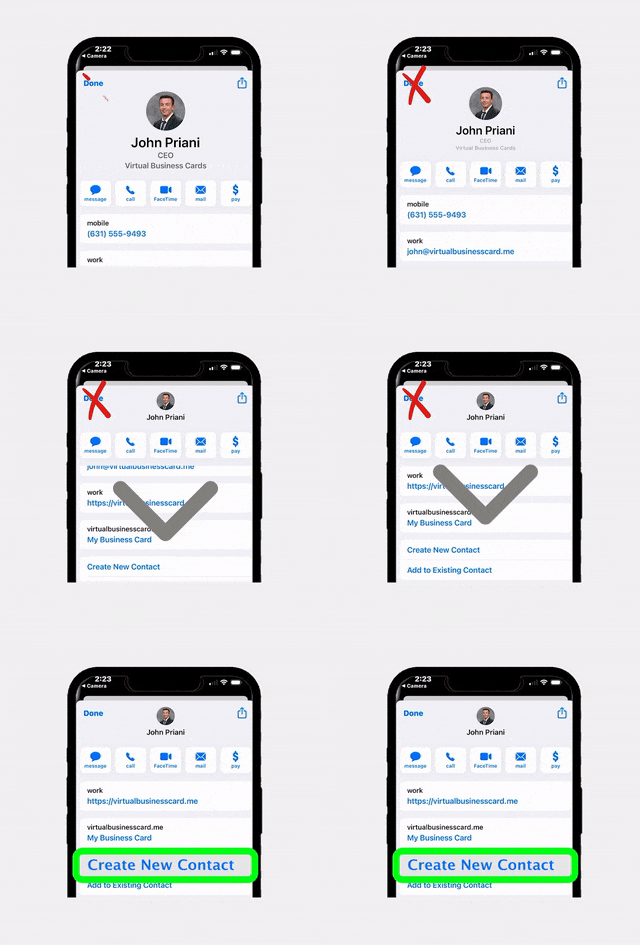
When someone receives your digital card, they can save your full contact information to their phone with a single tap. No typing, no scanning, no lost information. This seemingly small convenience has a massive impact on whether that person can actually find you when they are ready to buy or sell. The easier you make it for people to contact you, the more business you will close.
Environmentally Conscious Branding
An increasing number of consumers, especially younger buyers, care about sustainability. Eliminating paper business cards is a small but visible way to signal that you are environmentally aware. While this alone will not win you a client, it contributes to the overall impression of a modern, thoughtful professional.
Speed to Lead: The Real Advantage of Digital Networking
In real estate, speed wins. The agent who responds first to a new lead is significantly more likely to earn that client’s business. According to research published by the NAR, leads contacted within the first five minutes are far more likely to convert than those contacted after 30 minutes or more. Digital real estate networking gives agents a structural advantage in this critical speed-to-lead race.
Instant Data Capture
When you use digital tools at every networking touchpoint, lead information is captured instantly and accurately. There is no delay for manual data entry, no risk of misreading a handwritten phone number, and no forgotten contacts sitting in a coat pocket. Every new connection is immediately actionable.
Tools like EntryPointPro demonstrate this principle perfectly at open houses, where digital sign-in captures visitor information in real time and enables immediate follow-up. The same principle applies to digital business cards and other digital networking tools. The faster you capture the data, the faster you can act on it.
Automated Nurture Sequences
Digital-first agents do not rely on memory or manual task lists to follow up with new contacts. They set up automated email and text sequences that trigger the moment a new contact is captured. This ensures that every single lead receives timely, professional communication, even if you are in the middle of a showing or negotiation when the contact comes in.
Reducing the Gap Between Meeting and Meaning
Traditional networking creates a gap between the moment you meet someone and the moment you do something meaningful with that connection. That gap might be a few hours or a few days, depending on how busy you are. Digital networking compresses that gap to near zero. The contact is saved, the follow-up is sent, and the relationship is already building before you have even left the event.
Building a Scalable Referral Network Online
One of the greatest limitations of traditional networking is that it does not scale. You can only attend so many events, shake so many hands, and manage so many one-on-one coffee meetings. Digital networking, by contrast, is inherently scalable. Here is how digital-first agents build referral networks that grow exponentially.
Shareable Contact Information
A digital business card is not limited to one-to-one exchanges. When someone saves your digital card, they can easily share it with friends, family members, or colleagues who are looking for an agent. This viral sharing effect means that a single networking interaction can generate multiple referrals over time, something a paper card rarely achieves.
Social Media Integration
Digital-first agents embed their contact information and digital cards directly into their social media presence. Every post, story, and comment becomes a potential networking opportunity. When a follower sees your content and wants to reach out, your full contact information is one click away. This seamless integration between content and contact is what makes social media such a powerful networking amplifier for digital-first agents.
Cross-Platform Consistency
With tools like RealConnect, agents maintain a single, always-updated digital identity across every platform and interaction. Whether someone finds you on Instagram, meets you at an open house, or gets your card from a friend, they see the same professional, comprehensive profile. This consistency builds trust and reinforces your brand with every touchpoint.
Maintaining Long-Term Connections
Traditional networking often suffers from a “set it and forget it” problem. You meet someone, exchange cards, and then the relationship fades unless one of you makes a deliberate effort to stay in touch. Digital tools make it easier to maintain those connections through periodic updates, social media engagement, and automated check-in messages. Over time, these maintained connections translate into a steady stream of referrals.
Measuring ROI: Digital Networking vs Traditional Methods
One of the most compelling arguments for digital real estate networking is the ability to actually measure your return on investment. Traditional networking is notoriously difficult to track. You spend time and money attending events, but connecting a specific closed deal back to a specific handshake is nearly impossible.
Trackable Interactions
Digital business cards and networking platforms provide analytics that tell you exactly how many people viewed your card, saved your contact information, clicked on your listings, or scheduled a call. These metrics give you a clear picture of which networking activities are producing results and which are not worth your time.
Cost Comparison
Consider the typical costs of traditional networking: printing business cards (often $50 to $200 per batch), event registration fees ($25 to $500 per event), travel time, and the opportunity cost of hours spent away from revenue-generating activities. Now compare that to a digital business card platform that costs a fraction of those expenses and works for you around the clock. The cost-per-contact for digital networking is dramatically lower than traditional methods.
Conversion Tracking
When your digital networking tools integrate with your CRM, you can track the full journey from initial contact to closed deal. This allows you to calculate your true cost per acquisition for digitally sourced leads versus traditionally sourced leads. Agents who track these numbers consistently find that their digital leads convert at higher rates and lower costs.
Continuous Improvement
Because digital networking produces data, you can continuously refine your approach. If your analytics show that contacts from LinkedIn convert at a higher rate than contacts from local events, you can reallocate your time accordingly. This data-driven approach to networking is simply not possible with traditional methods, where results are largely anecdotal.
To explore affordable plans that include digital business cards and other essential agent tools, it is worth comparing the cost to what you currently spend on traditional networking activities. Most agents find the switch pays for itself within the first month.
Frequently Asked Questions
Do digital business cards completely replace paper business cards?
Not necessarily. Some agents find value in carrying a small number of paper cards for situations where a physical exchange feels appropriate. However, a digital business card should be your primary networking tool because it is more interactive, easier to share, and far less likely to be lost or discarded. Most digital-first agents find that over time, they rely on paper cards less and less.
How does digital real estate networking help with lead follow-up?
Digital networking tools capture contact information instantly and can integrate with your CRM and email marketing platforms. This means follow-up messages can be sent automatically within minutes of a new contact saving your information. Faster follow-up leads to higher conversion rates, which is one of the primary reasons digital-first agents close more deals.
Is digital networking effective for agents in smaller or rural markets?
Absolutely. In fact, digital networking can be even more impactful in smaller markets where in-person networking opportunities are limited. A strong digital presence allows you to connect with potential clients and referral partners beyond your immediate geographic area, expanding your reach without requiring travel to distant events.
What is the best way to start transitioning to digital networking?
Start by setting up a digital business card with a platform like RealConnect. Include links to your listings, reviews, social media profiles, and scheduling tool. Add your digital card link to your email signature and social media bios. From there, gradually integrate digital tools into your open house strategy, follow-up process, and referral outreach. The transition does not have to happen overnight.
Can I track who views my digital business card?
Yes. Most digital business card platforms provide analytics showing how many people viewed your card, which links they clicked, and how often they returned to your profile. This data helps you identify your warmest leads and prioritize your follow-up efforts accordingly.
Ready to Network Smarter and Close More Deals?
Join the growing number of real estate professionals using RealConnect digital business cards to make stronger first impressions, capture leads instantly, and build referral networks that scale with their business.






 Icon On The Top Right Is the Menu For Your Card. This Is Where You can edit your card and log into your dashboard.